Companies news
Airbus A350-1000ULR completes its longest development flight from Toulouse to Melbourne
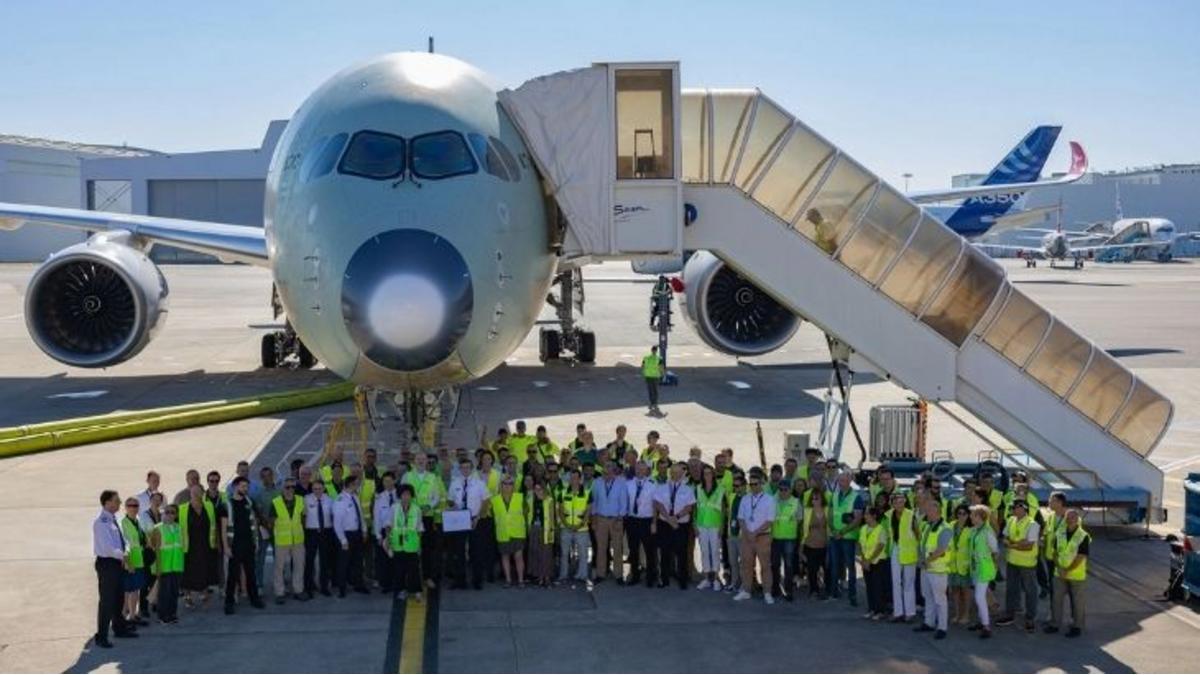
Airbus completes a 24-hour A350-1000ULR test flight between Toulouse and Melbourne, evaluating fuel systems, cabin conditions and crew rest.
On 23rd July, the first A350-1000ULR flight test aircraft MSN707 embarked on its longest point-to-point flight from Toulouse, France direct to Melbourne, Australia. A few days later, the aircraft returned to Toulouse with two Qantas pilots on board, landing on the morning of 28 July. Airbus Test Pilot Xavier Pepin, who captained the aircraft on the return flight, discussed the mission, which covered 12,460 nautical miles in 24 hours and 24 minutes.
Aims of the long-range flights with MSN707
This flight-test aircraft, MSN707, which first flew on the 2nd of June, is equipped with specialised instrumentation and is now really ‘stretching its legs’ for the first time. Its two-part voyage is technically classified as a ‘development’ flight test (as distinct from a ‘certification’ flight test).
The goal is to demonstrate that the aircraft, powered by two Rolls-Royce Trent XWB-97 engines, can perform a 23-hour ‘block time’ flight. This is the duration from releasing the parking brake at departure to setting it at the arrival stand – to ensure coverage for the customer’s intended 21 hours 40 minutes flight time (plus holding, diversion and taxi times at departure and arrival), for its forthcoming “Project Sunrise” routes.
In particular, the mission also serves to validate cabin comfort through air conditioning (ATA Chapter 21) measurements and fuel management systems (ATA Chapter 28), particularly the additional rear center tank (RCT) – with a 20,900 litre fuel capacity – which enables ultra-long-range (ULR) flights to cover a distance of almost 10,000 nm.
Xavier Pepin explained:
“Whilst we have already demonstrated much of the RCT’s functionality earlier in the flight test campaign, we finalised some remaining test points in these long-range flights. So, we filled this tank to validate all necessary parameters during the mission, making this, along with cabin comfort, the primary focus of our testing. During the first leg we also made use of the time (the flight lasted approximately 20 hours) to stabilise various air temperature settings to ensure accurate measurements. So, while much of the testing goals were already tackled on the outward leg, the second leg addressed any backup test points that were not completed during the first leg.”
Furthermore, the crew evaluated the ULR’s twin Flight Crew Rest Compartment (FCRC) – which was extensively instrumented to measure the air conditioning performance. This new module, designed for the -1000ULR’s ultra long missions, features two separate sections with individual entrances. The configuration is intended to allow pilots to enter or leave their respective rest areas without disturbing one another during airline operations.
Flight crew roster and routing aspects
For the outward leg there were four Airbus pilots, with Test Pilot, Vincent Sibelle, as captain (and also being responsible / in-charge of the overall mission organisation). The other three pilots on board were Xavier Pepin, Josef Bayoud and Chetan Takalkar. In addition to these pilots, the crew included two Test-Flight Engineers (TFEs), Laurent Rossignol and Nicolas Granier, who were seated in the cockpit to monitor aircraft systems and three Flight-Test Engineers (FTEs), Tuan Do, Alexia Plumet and Jaime Angoloti, who were seated at their flight test workstations (in the main cabin) to coordinate all tests including cabin comfort and fuel monitoring.
For the return leg – from Melbourne back to Toulouse – Airbus Test Pilot, Xavier Pepin, was designated as captain. Moreover, for this leg two Qantas pilots Captain Andrew Coull and Captain David Summergreene joined the crew and one of the Airbus pilots disembarked. The return flight there were five pilots on board – comprising three Airbus pilots plus the two Qantas pilots who are already qualified on the A350, but who were new to the ULR variant. Meanwhile, the two TFEs and three FTEs were the same as for the outward flight.
The longer return flight departed Melbourne, crossed the Pacific towards Los Angeles, continued across the United States and Canada, crossed the Atlantic south of Greenland and passed over the United Kingdom before reaching southern France.
Xavier explained that for the return flight a northerly Atlantic path was chosen to avoid the published tracks in use by airlines that might not be updated by the time of takeoff, thereby avoiding potential Air Traffic Control (ATC) issues, such as mis-matching flight plans.
Fatigue management and crew rest during the flight
Xavier Pepin recalled:
“To manage fatigue during the 20 to 23-hour flights we implemented four-hour shifts for each pilot, but we rotated the crew every two hours. This staggered approach ensures that when a new pilot joins the cockpit, they overlap for two hours with the outgoing pilot. This facilitates a thorough handover and maintains full situational awareness. Additionally, for the second flight leg, at least one Airbus test pilot was always seated in a pilot seat when a Qantas pilot was in the other seat to ensure mission safety, as Airbus holds responsibility for the operation. We have applied this same structure to manage rest periods effectively.”
Notably, because the aircraft’s new ‘twin’ flight crew rest compartments were ‘occupied’ with ventilation measurement equipment, the crew used instead the eight-berth cabin crew rest compartment at the rear of the aircraft for their sleep. Xavier Pepin concluded:
“In the rear cabin crew rest compartment, since there weren’t any passengers or cabin crew, we could quickly return to the cockpit or FTE station at any time if needed. We have organised a schedule to allow a Qantas pilot to take the controls at specific times. These pilots are already qualified on the A350, and this mission provided them with their first experience with the -1000ULR variant. We really enjoyed and appreciated exchanging knowledge and addressing their questions during our ultra-long-range voyage together.”